
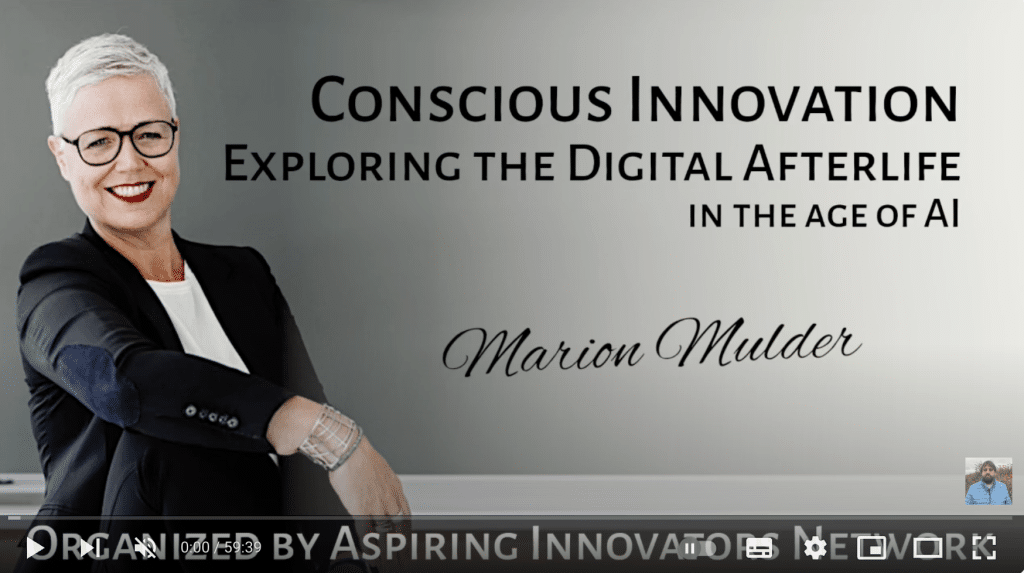
Last week I gave a talk at the talk about conscious innovation exploring the digital afterlife at the Aspiring Innovators Network organised by Dirk Jan Buter. Here you can read the outline of my keynote.
Hello, everyone! Today, I’m excited to explore a topic that’s close to my heart: conscious innovation and, more specifically, digital afterlife in the age of data and AI. I’ll start by giving you a bit of background on myself and my perspective on conscious innovation.
For the past 20 years, I’ve worked in digital innovation, wearing different hats—project manager, product owner, and more—bridging the needs of people and the capabilities of technology. I’m passionate about technology, but about eight years ago, I started questioning its impact in a new way. My encounter with AI began with a project focused on conversational AI and virtual assistants, which we now commonly refer to as chatbots. Working on this project, I had a moment of pause: just because we can create these tools, should we? I started noticing issues related to inclusion, representation, and bias, especially as I realised that nearly all virtual assistants were designed to have female personas. This observation led me down a path of exploring the relationship between technology and diversity, leveraging my experience as a co-founder of Workplace Pride, a foundation for LGBTQ+ inclusivity in the workplace.
These experiences deepened my commitment to conscious innovation. For me, conscious innovation involves not only creating new technologies but doing so with an awareness of their broader impact. Are we solving real problems, or are we innovating for the sake of novelty? How might these developments affect people’s lives, and are they aligned with the values we want to uphold?
Recently, I’ve become increasingly interested in Consciousness and wisdom, which has further informed my work. Just last month, I attended the Wisdom and AI summit in San Francisco, where thought leaders like Sam Altman and Deepak Chopra discussed the intersection of technology and Consciousness. I’m not alone in my exploration—there’s a growing movement to understand how wisdom and Consciousness integrate with technology. This brings me to digital afterlife, a topic that’s been “bubbling” in my mind for over a decade.
The concept of digital afterlife first caught my attention in 2011 when I read Total Recall: How the E-Memory Revolution Will Change Everything by Gordon Bell and Jim Gemmell. Back then, the idea of “e-memory” was intriguing but futuristic. Bell imagined a world where he could capture his entire life digitally through a live-log, creating a legacy that would outlive him. Fast-forward to today, and many of those predictions are no longer hypothetical—they’re our reality.
Key Areas of Discussion
Today, I’d like to explore several topics with you, such as:
- Do you have a last will or testament?
- Have you considered what your digital legacy might look like?
- Concepts like digital immortality, digital footprint, and digital resurrection.
- The growing role of digital twins and the impact of transhumanism on how we perceive life, death, and legacy.
In our increasingly digital world, many of us already have a digital afterlife, whether we’ve planned it or not. Unless you’re one of the few without social media or any online presence, you’re leaving a digital footprint behind. This footprint—social media accounts, blogs, websites, even voice and video recordings—is part of a larger digital legacy. As we start thinking about what we want to happen with this data when we’re gone, practical questions arise. For instance, many social media platforms, like Facebook and Instagram, offer the option to memorialise or delete accounts after death. These choices allow us to have a say in our digital legacy, rather than leaving it to chance or big tech.
Ownership and Control of Digital Data
A key concern is data ownership. Much of our digital information is in the hands of corporations like Meta (formerly Facebook), who control platforms like WhatsApp, Instagram, and Facebook. When we pass on, who will ultimately control this data, and for how long? If we leave our accounts without guidance, our families will face these decisions, and our data will likely end up managed by corporate entities. If, or when, the ownership of these platforms changes, what happens to our data then?
Another aspect to consider is the relationship between our digital footprint and AI. Currently, AI models are often trained using publicly available data, including social media posts and other online content. So, not only is our data preserved, but it’s also influencing AI long after we’re gone.
Digital Afterlife Services
A number of new apps and services are now emerging to address these concerns. In the Netherlands, for example, an app called “About Time” guides users in having conversations about death, encouraging people to prepare for their digital afterlife and create a list of their online accounts and preferences for each. For those looking for ways to actively preserve memories, services like Hereafter AI and You Only Virtual go a step further, offering solutions that allow loved ones to engage with a digital version of you after you’re gone.
These services vary in approach. Hereafter AI uses audio recordings to create a voice-driven interface, while You Only Virtual uses more advanced techniques, cloning voices, faces, and even mannerisms. With AI-generated deepfakes, these virtual versions can respond in real-time and simulate interactions that feel remarkably lifelike. However, ethical questions arise: is this good for grieving? Does interacting with a digital version of someone postpone or aid in healing?
Project December offers another perspective on digital resurrection. For a modest fee, you can create an AI version of a loved one, similar to what tech leaders like Reid Hoffman have done. This opens up possibilities not only for the wealthy but for anyone willing to pay a small fee, sparking questions about accessibility and intent. These examples reflect how quickly technology is evolving, as well as the societal implications of making digital afterlife mainstream.
The Future of Digital Afterlife: Ethics and Transhumanism
If you’re interested in where digital afterlife may be headed, I recommend watching The Future Of on Netflix, specifically the episode on life after death. It envisions cemeteries where you can interact with a digital version of a deceased loved one through a secure, blockchain-based interface. Taking it further, the episode speculates about storing data in biological formats, such as plants, creating a living “data storage” that holds a digital version of a person.
Digital afterlife is no longer just a futuristic concept. With current AI capabilities, the question is not if we’ll embrace digital afterlife but how we’ll do it—and what boundaries society and individuals want to set. Conscious innovation asks us to consider: just because we can, should we? How can we ensure these technologies serve humanity in a sustainable, ethical way?
Opening the Dialogue on Digital Afterlife
These developments urge us to think carefully about our digital footprint, data ownership, and the role of AI in our lives after death. This isn’t just a technical conversation; it’s deeply personal and requires careful thought. As a futurist, my goal is to facilitate these discussions, helping individuals and organisations navigate the ethical, social, and practical dimensions of digital afterlife.
If you’re interested in learning more or would like to discuss how digital afterlife fits into your organisation’s approach to innovation, please reach out. I’m passionate about shaping technology that respects humanity, honours legacies, and aligns with conscious innovation principles. Together, we can explore what it means to create a digital legacy that serves both present and future generations.